Managing Novel AI Risks
AI risk management is the foundation of every mature IT and AI governance program. AI adds a new layer on top of existing risk processes: novel risks, compounded existing ones, and a pace of change no quarterly review can keep up with. trail gives you the library, structure, and automation to manage AI risk continuously.
In brief
Effective IT risk management is already complex before AI enters the picture. But AI adds a new layer on top: it introduces novel risks, compounds existing ones, and changes faster than any quarterly review cycle can keep up with. With trail, you identify the right risks for every asset, assess them in depth, link mitigating controls, and keep the whole picture live – not frozen in a point-in-time report.
With trail's AI risk management capabilities, your organization can:
- Identify AI-specific risks fast: Draw on a curated library of 150+ AI risks and threats, grounded in sources like MIT, OWASP, NIST and BSI – or bring your own risk library.
- Get the right risks recommended automatically: Risks map to triggers (like model type, data type, and other technical specifications) and surface both per asset and across the whole organization. You can also link risks to your RoPA records with trail.
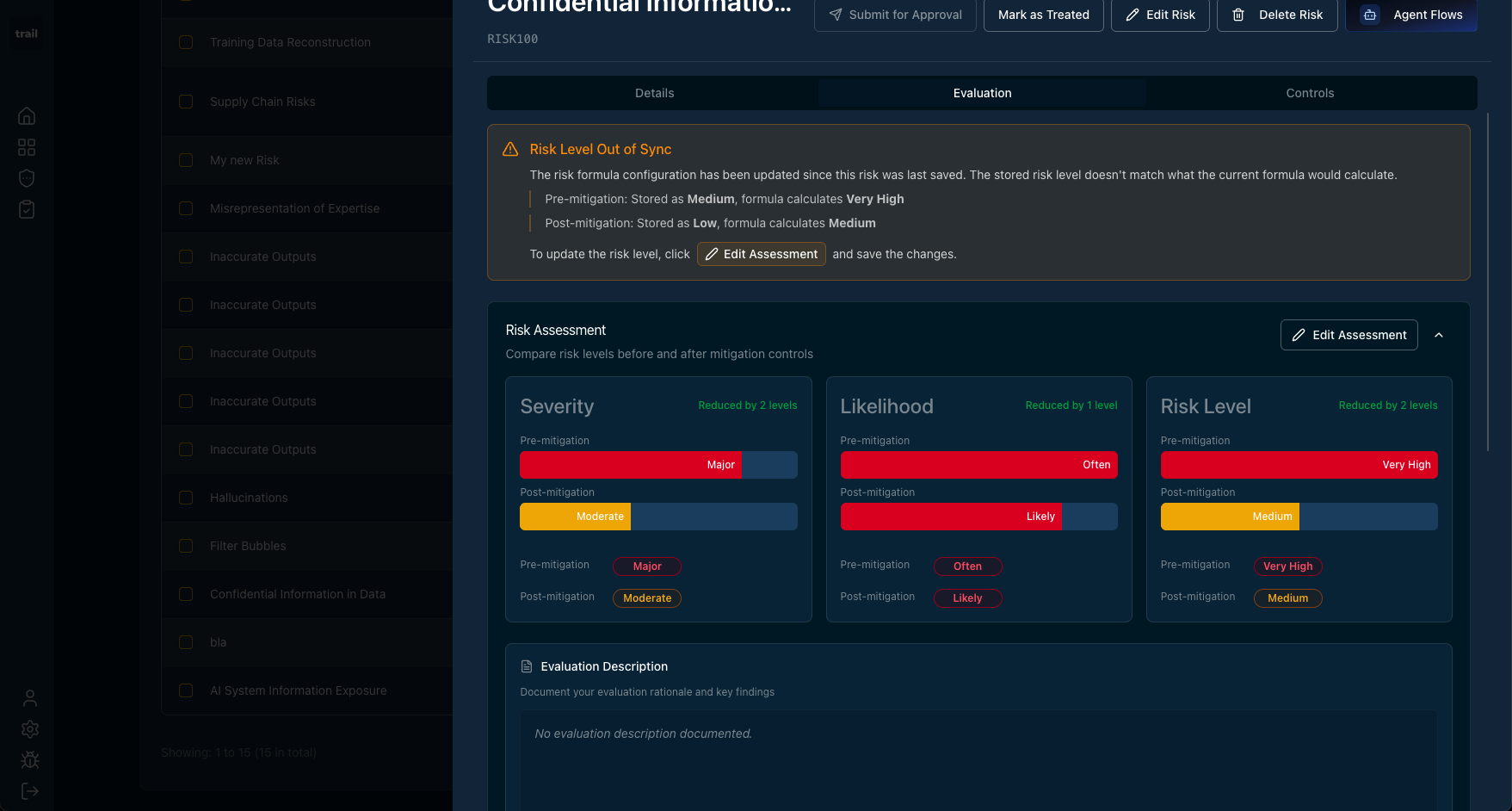
- Assess risks: Score severity and likelihood pre- and post-mitigation, set residual risk, and visualize a risk matrix according to your risk scheme.
- Link mitigations directly: Auto-recommend and attach controls to counter each risk.
- Keep it continuous: Live dashboards and alerts replace static, point-in-time assessments.
- Assign clear ownership: Auto-map owners and approvers by role, with notifications.
How do you identify and assess AI risks?
AI systems, models, vendors, and agents introduce risk categories that traditional frameworks were never designed for, such as bias and fairness issues, agentic autonomy, high-stakes use cases, and more. To manage them, your teams first need to know what those risks are, which ones are AI-specific, and which apply to any other IT asset or the whole organization. Without a shared taxonomy and a single source of truth, risk information ends up buried in outdated assessments and scattered across departments. This makes reporting and communicating risks difficult – and makes it harder to justify your governance investments.
Build on a living, AI-specific risk library based on real research
Staying up-to-date on what new risks emerge while AI technologies evolve is not feasible for most organizations. However, there is great research already out there that you can and should utilize for your AI risk management. trail provides a comprehensive, continuously updated library of 150+ curated AI and IT risks, grounded in current research from sources like MIT, OWASP, and BSI. Templates span high-risk AI uses, agentic AI, fairness and bias, ethics and impact, as well as information security, data privacy, and vendor management. Your team can use the templates as-is, customize them, or import your own risks. Additionally, trail comes with a curated control library that already gives you a head start in finding the right mitigation measures for each risk, while also matching controls to compliance requirements – like those from the EU AI Act, where applicable.
Assess each risk in depth
trail guides risk management as a clear, repeatable workflow: Identification → Evaluation → Mitigation → Review.
Risks are classified and described (e.g. category, sector, origin, citations), scored by severity and likelihood both pre- and post-mitigation, and given a residual risk level after mitigation. Your risks and assessments can then be visualized in an interactive risk matrix and dashboards.
Make ownership and accountability explicit
Risk management is inherently multi-stakeholder – spanning security, privacy, legal, financial, and operational owners. trail removes the coordination overhead by auto-assigning owners and approvers based on your organization's risk logic and role concept, so the right people get notified and act at the right time. Everyone keeps visibility while specific stakeholders stay accountable.
How do you stop AI from quietly reshaping the risks you already manage?
AI doesn't just add new risks – it changes the shape of the ones you already track, and it does so continuously. A model updated silently, a vendor's posture shifting, or a low-risk tool repurposed for a higher-stakes use case can all invalidate an assessment that was accurate six months ago.
Re-evaluate the existing risks AI compounds
Topics like data governance and vendor management take on new dimensions in the AI world. Third-party systems are particularly difficult to assess for risk, as it is often unclear how they work internally. Existing data and supply-chain risks can be amplified in ways that warrant a fresh look. trail's risk library covers these traditional IT risk areas alongside AI-specific ones – and supports custom risk creation – so nothing falls between the cracks.
Govern third-party AI risk alongside your internal systems. Learn more about third-party AI governance.
Move from point-in-time to continuous monitoring
In trail, risks can be tracked, updated, and measured continuously. Assessments become live dashboards rather than static documents: risk overviews for leadership, filterable by category, use case, and other attributes, as well as personalized views of the assets each user owns. Alerts trigger on your own organizational and asset criteria, and control-effectiveness results feed straight back into risk status – so your risk picture reflects current reality.
Learn how trail evaluates control effectiveness automatically and keeps risk status current. Read the control assessments article.
trail vs. the traditional approach
Organizations must adapt existing risk processes to be more dynamic, proactive, and AI-aware. Here is how managing AI risk in trail compares to the traditional way:
Ready to take control of your AI risk?
trail gives you the library, structure, and automation to identify, assess, and mitigate AI risk continuously – with clear ownership and live oversight. Get in touch to see how trail fits your risk management program from day one.
FAQ
How is AI risk management different from traditional risk management?
AI introduces new risks and compounds existing ones that traditional frameworks can't fully address. trail adds an AI-aware layer – covering bias, fairness, ethics, agentic AI, and high-risk uses – on top of established practices.
What is trail's risk management solution?
A native system to identify, assess, and mitigate risks across your AI and IT systems. It provides the library, workflows, and ownership model to manage threats proactively before they become incidents.
Where do trail's risk templates come from?
trail's library of 150+ curated AI and IT risks is grounded in current research from sources like MIT, OWASP, NIST, BSI and more, and is continuously updated. New entries can be added on request or imported from your current libraries.
Can I import our existing risk register?
Yes. You can create custom risks or import them and trail maps them to its schema so they work alongside the built-in library. trail also integrates with existing risk-management processes and systems to facilitate communication.
How does trail handle risk ownership and accountability?
trail can auto-assign owners and approvers to risks based on your organization's role concept and risk logic. Assigned users get notified and can act at the right time, keeping accountability clear across security, privacy, legal, and operations.
Is risk management in trail a one-time activity?
No. Risks are tracked, updated, and measured continuously. Assessments become live dashboards rather than static documents, giving every user real-time visibility into the current governance status.