The AI Registry with Superpowers
A centralized AI Registry is the foundation for effective AI governance. It provides a living system of record to gain visibility into your AI landscape – from discovering AI to managing assets across the whole lifecycle – while empowering teams to scale compliant AI deployment through automated and self-serve processes.
In brief
As enterprise AI adoption accelerates, organizations often struggle to keep track of their AI models, use cases, agents and third-party tools. See why a centralized AI Registry is a crucial first step for effective AI governance and how you can give it superpowers.
We break down the two main challenges: (1) gaining visibility into your AI landscape and (2) properly assessing your assets – and show how trail's automated, living AI Registry replaces fragmented collections to help you innovate confidently.
In one view:
With trail’s registry, your organization can:
- Centralize AI assets: Store and map dependencies for all AI models, systems, agents, and vendors in one living hub.
- Automate AI discovery: Detect and sync shadow AI instantly from your existing GRC and developer tools or agent builders across the organization.
- Manage ideation: Evaluate use case ideas centrally to identify governance requirements early and accelerate innovation.
- Enrich assessments of AI: Automatically pull relevant context and data for faster, more accurate risk evaluations.
- Scale governance with self-serve: Empower business and engineering teams with standardized workflows to reduce bottlenecks in compliance teams.
- Customize workflows: Dynamically map the right policies, controls, and alerts to each asset based on its unique risk profile.
- Govern AI vendors: Seamlessly integrate third-party AI risk management alongside your internal systems.
Why do you need an AI Registry? And what does a great one look like?
Problem 1: Gaining visibility into your organization
Creating a ground truth for governance
To be able to govern AI you first need to keep track of AI. This is often the first major hurdle for most enterprises. AI assets are fragmented across disparate tools and disconnected business units or teams, often living in messy Excel spreadsheets . Without a centralized view, leadership lacks visibility into what AI projects and assets are actually ongoing or live, who owns them, and what their current governance status is.
trail solves this by providing a living, continuous system of record. The AI Registry of trail collects and stores all relevant information for your AI models, agents, systems, use cases and vendors in one accessible hub. Beyond just listing assets, trail uniquely maps and visualizes the intricate dependencies between them, giving you a complete, interconnected overview of your AI landscape and its compliance posture. This allows you to make use of already performed assessments or collected evidence of your model or vendor, for instance, across multiple assets later on, or it can give you a better understanding of how requirements or risks may change on a use case if an underlying model has changed.
Discovering AI assets
Building on the visibility challenge, simply finding and discovering (shadow) AI is a massive operational burden – which is even more challenging with the rising amount of AI agents. Data about these assets is often buried in legacy platforms, developer tools, agent builders, or isolated silos. Manually hunting down untracked systems to keep an inventory up to date across a large organization is inefficient and often prone to human error.
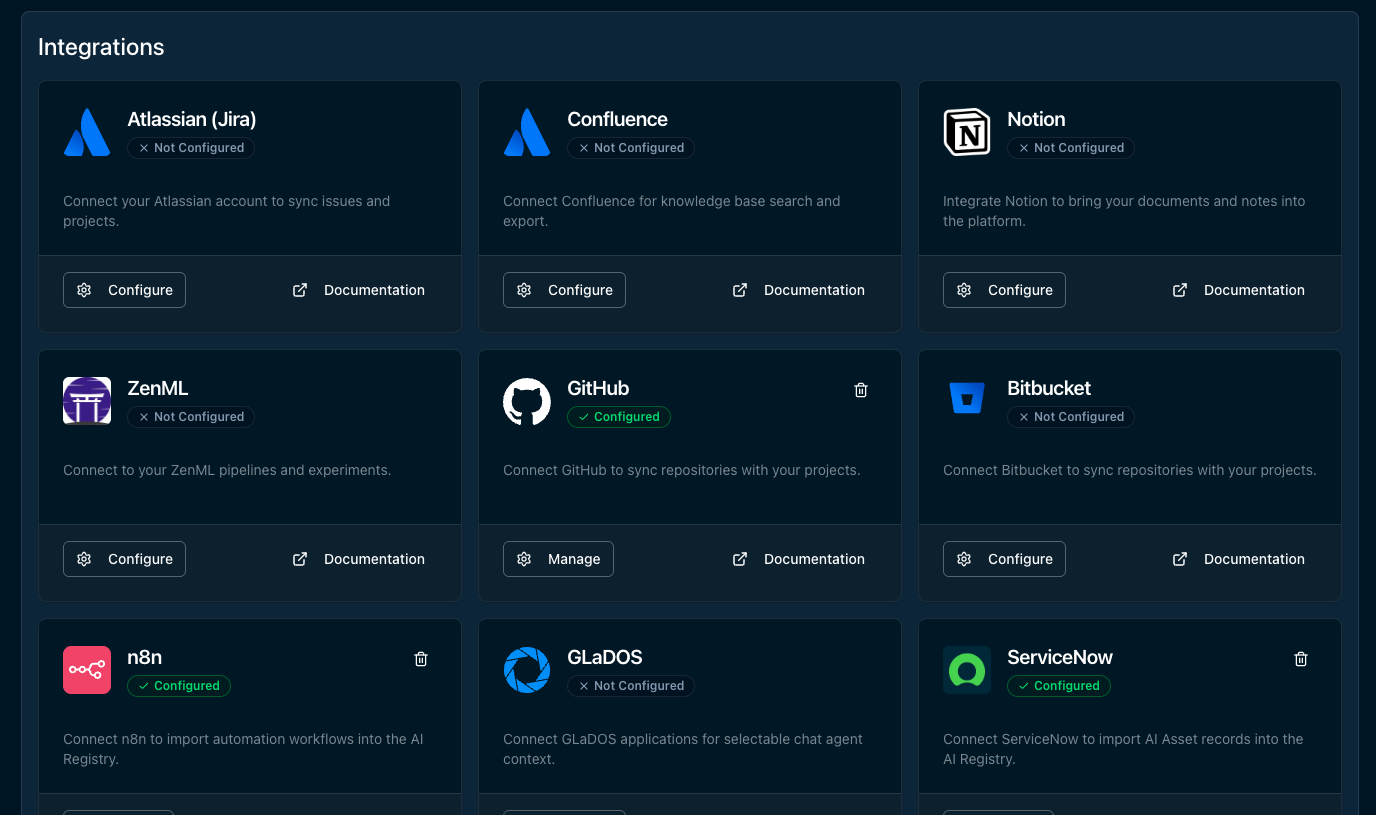
trail automates this AI intake process through integrations with your existing asset inventories, GRC platforms, and the environments where AI is actively built (these sources can include tools like OneTrust, ServiceNow, Collibra, SAP LeanIX, Notion, Confluence, MLOps platforms like Databricks, or agent builders like Microsoft Copilot Studio or n8n, just to name a few). These connections can seamlessly detect and pull AI assets directly into the registry. Where needed, trail can also write back updated governance data to your preferred central system of record, ensuring your broader enterprise architecture stays perfectly in sync without double documentation and creating new silos.
Managing use case ideas
Effective AI governance does not begin at deployment or when you start your procurement process – it already starts during use case ideation. This initial planning stage inherently shapes future governance requirements and potential risks. And this is why in most organizations with an advanced governance maturity, you typically find governance specialists as part of the AI Center of Excellence or innovation unit supporting in that early stage. However, without a structured process, teams often keep working in silos, leading to disjointed evaluations, delayed decisions, and potentially overlapping entries for similar use case ideas across the company.
trail allows organizations to centrally manage and evaluate new AI ideas across teams in a structured, transparent way. By capturing potential risks and requirements from day one, it eliminates duplicate requests and streamlines approvals, e.g. by defining greenlighting conditions for fast-track AI deployments. Instead of acting as a blocker, this early-stage governance involvement becomes a true innovation driver, guiding teams to build compliant, high-value AI much faster.
Problem 2: Know your AI
Having the right information for your AI assessment
When you collect your AI assets the next step is to assess them to identify the necessary governance requirements and risks. Assessing an AI asset requires a deep understanding of its context, data, and technical specifications, however. Unfortunately, reviewers usually have to chase down this information across scattered documents, code repositories, suppliers and teams. This manual data gathering delays assessments, and hence your AI deployment, and could even lead to incomplete risk profiles.
trail automatically pulls and enriches asset data from your existing tools, repositories and other sources, such as attached PDFs or configuration files, through integrations – and by using agents. trail’s Agent Flows are an especially powerful tool to help you assess the relevancy of your collected sources and to further populate questionnaires and the asset cards containing all relevant information about your asset.
Learn how 1 person can do the work of 5 by using Governance & Compliance Agents.
Standardizing governance workflows for effective self-serve
A lack of standardized procedures and assessments to understand the risks and governance requirements of an AI asset better often leads to incomplete data across different departments. And this absence of a clear process additionally generates confusion for technical and business (1st LoD) teams, who are left guessing what is actually required for proper governance. With GRC teams typically facing limited headcount, manually guiding every AI project is impossible. Ideally, organizations need a self-serve approach that empowers the teams who bring in the AI use cases to meet 80-90% of governance requirements independently, freeing up human resources. Therefore, a key struggle is instructing your teams what to do and when.
trail’s AI Registry not only collects your assets and their relevant information but also provides helpful user guidance, such as recommending the right and standardized assessments and questionnaires for a specific asset.
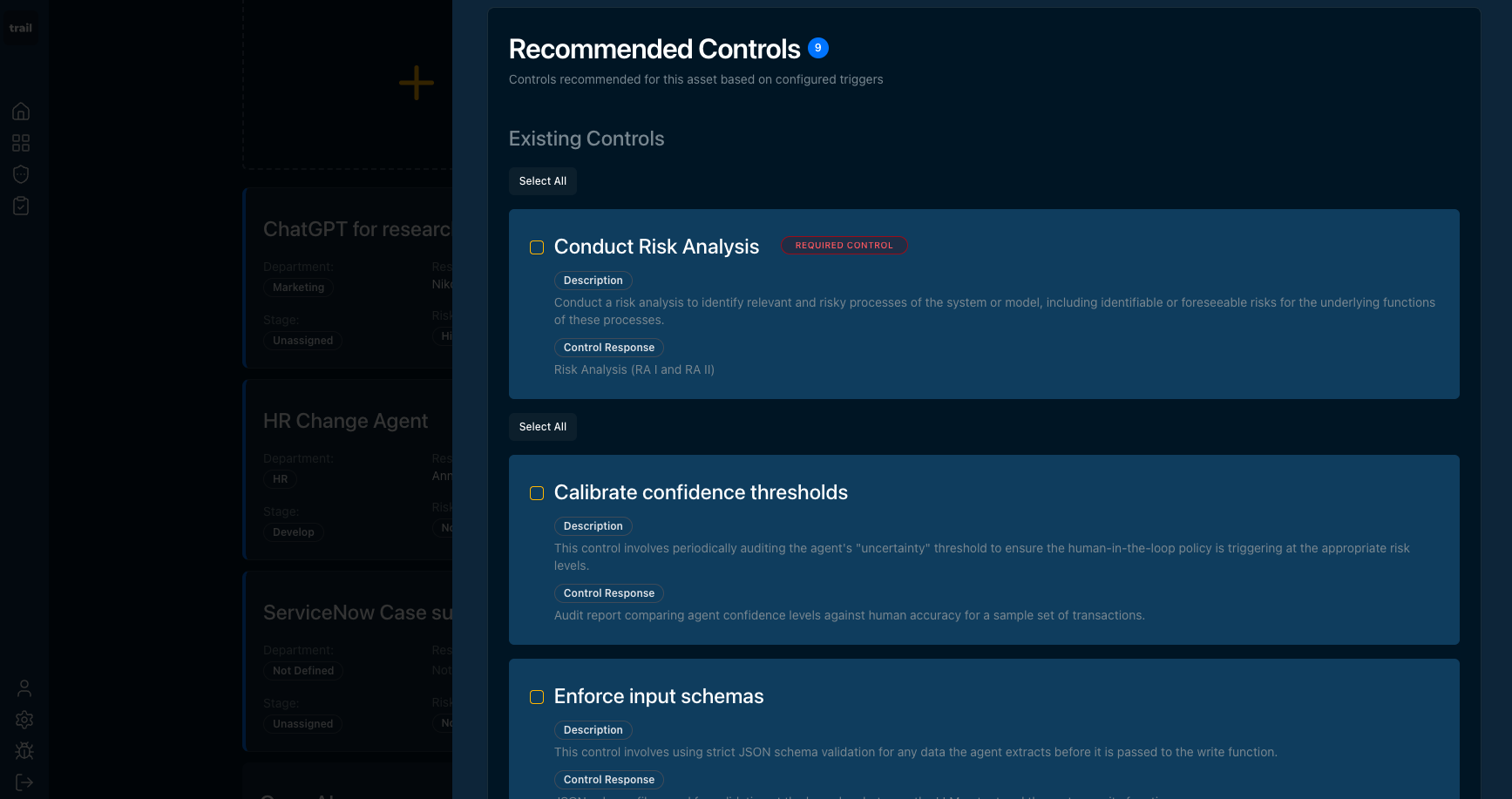
Additionally, trail then recommends the right governance requirements coming from your policies, the necessary controls to implement or check for and the potential risks to mitigate. All from your asset card and supported with dashboards and analytics to oversee governance status, as well as trail’s Agent Flows to automate end-to-end compliance processes. We’ve designed all of these features in a user-friendly experience for both your 1st LoD and the 2nd LoD.
Managing AI vendors
With the adoption of third-party AI systems, organizations face significant supply chain risks. Tracking which external vendor supplies critical AI models or agents and validating if a vendor adheres to your requirements is incredibly difficult when procurement and IT remain disconnected. This lack of vendor oversight exposes the business to unmanaged security and compliance vulnerabilities.
trail incorporates vendor and third-party AI risk management into your AI governance starting already in the AI Registry. It tracks external vendors alongside internal systems, mapping how third-party tools connect to your internal processes and dependencies. By collecting and even recommending evidence and data sources around your third-party provider, trail helps you speed up vendor assessments. This allows you to confidently procure and deploy external solutions while tracking value drivers and maintaining strict compliance standards according to your controls.
Learn what makes third-party AI governance difficult and how trail helps you with it.
trail vs. the traditional way of keeping track of AI
When organizations outgrow manual spreadsheets and fragmented tools, the need for a unified AI Registry with useful and powerful automations becomes clear. Here is how managing your AI initiatives with trail’s centralized, automated approach compares to the traditional, siloed way of handling AI and IT governance:
Ready to take control of your AI landscape?
Move beyond fragmented spreadsheets and disjointed tools: trail provides an enterprise-ready, highly customizable AI governance software solution made for your organization's workflows and scale. Our automations help you gain back focus on the high-risk AI cases while helping you to avoid being the blocker for innovation. Get in touch with our team today to discover how trail can help you build trustworthy, compliant, and high-value AI with confidence and speed.
FAQ
What is an AI Registry and why do I need one?
An AI Registry is a centralized system of record for all your organization's AI assets — models, agents, systems, use cases, and third-party vendors. Without one, AI projects are scattered across disconnected teams and tools, making it impossible for leadership to know what's running, who owns it, or what its compliance status is. It's the foundation for any effective AI governance program.
What types of AI assets can I track in trail's registry?
trail tracks AI models, agents, systems, use cases, and third-party vendors in a single hub. It also maps the dependencies between these assets — so you can see, for example, how a change to an underlying model affects all the use cases built on top of it.
How does trail discover AI assets to avoid manually logging assets?
trail integrates with your existing asset inventories, GRC platforms, and developer tools — including platforms like OneTrust, ServiceNow, Collibra, SAP LeanIX, Databricks, and n8n, among others. These integrations automatically detect and pull AI assets (including shadow AI) into the registry, so you're not relying on manual inventory updates.
Can trail sync back to our existing systems of record?
Yes! Where needed, trail can write updated governance data back to your preferred central system — whether that's a GRC platform or enterprise architecture tool — keeping everything in sync without creating new silos or requiring double documentation.
When should governance start in the AI lifecycle?
Governance should begin at the ideation stage, not just at deployment or procurement. trail lets teams submit use case ideas centrally, capturing potential risks and requirements from day one. This eliminates duplicate requests, streamlines approvals, and defines fast-track conditions for low-risk deployments — turning governance into an innovation driver rather than a blocker.
How does trail help with risk assessments?
trail automatically pulls and enriches asset data, such as from your developer tools, repositories, PDFs, and configuration files. The Agent Flows in trail can assess the relevance of collected sources, fill out questionnaires, and populate asset cards — reducing the manual data-gathering that typically delays assessments and deployment.
How does trail support teams that aren't governance specialists?
trail is designed for a self-serve AI governance model. It recommends the right standardized assessments, questionnaires, governance requirements, controls, and risks directly from each asset card to the respective user or owner. The goal is to empower technical and business teams (1st Line of Defense) to meet 80–90% of governance requirements independently, freeing up your GRC team for higher-value work.
Does trail handle third-party and vendor AI risk?
Yes. Third-party AI risk management is built into the platform, as trail tracks external vendors alongside internal systems, maps how third-party tools connect to your internal processes, and helps speed up vendor assessments by collecting and recommending relevant evidence. This lets you procure and deploy external AI while maintaining compliance.
How is trail different from Excel or our existing GRC tool?
Spreadsheets and traditional GRC tools require manual updates, lack dependency mapping, and don't connect to the environments where AI is actually being built. trail provides live integrations, automated discovery, version control, change logs, role-based access, and Agent Flows that automate whole compliance processes — replacing email threads and fragmented tooling with a single governed layer.
Which compliance frameworks does trail support?
trail is designed to support major AI governance frameworks including the EU AI Act, ISO 42001, and NIST AI RMF. It maps policies, controls, and alerts to each asset based on its risk profile, allowing organizations to customize workflows to their specific regulatory requirements. You can import and create your own policies and frameworks too!